
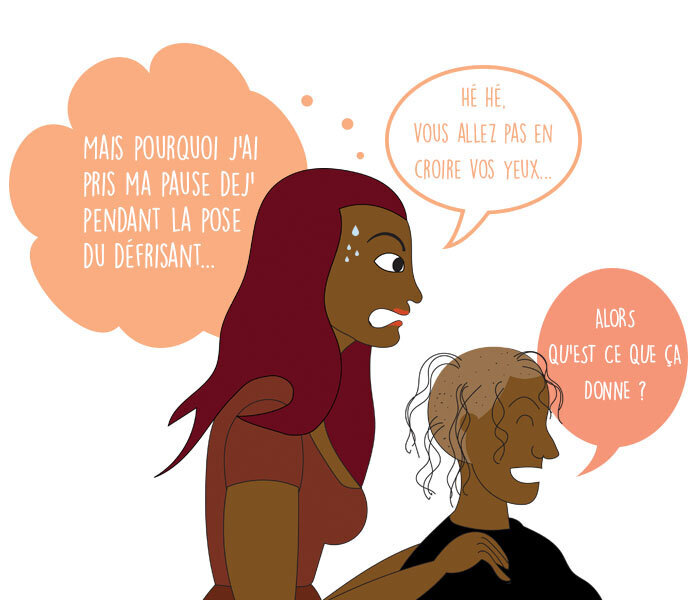
I'm sure many of you have considered relaxing your hair. Perhaps most of you have even taken the plunge already. But did you know that hair relaxing comes with risks? Serious risks, in fact! This article aims to caution you and, for those still considering it, provide guidance for a successful relaxing process.
Many women with curly or coily hair have been tempted by hair relaxing. It must be said that it allows you to have flowing hair, to be a dandruff-free star like in L'Oréal commercials, but also and above all, to fit into the norm. Yes, we must be realistic, but even in 2017, it's easier to accept long, straight hair than a beautiful afro cut. What can you do, dear readers, we are still far from breaking free from the constraints imposed by Western standards. But be careful, hair relaxing is not without danger. Here are a few things to know before getting your hair relaxed.
What is Hair Relaxing?
Before diving into the heart of the matter, let me first explain what hair relaxing truly is. Hair relaxing is an alkaline chemical product whose purpose is to transform the nature of coily and curly hair by making it straight. This transformation is irreversible. The only way to remove the relaxer is to cut the hair. This alkaline product breaks your hair fiber. In fact, it modifies the spiral organization of keratin molecules to give the hair a new straight structure.
There are two types of cold relaxers: lye-based or no-lye. The difference between the two lies in the alkaline compound that opens the hair cuticles. In lye-based relaxers, it's lye that opens the cuticles, whereas in no-lye relaxers, it's lithium hydroxide, or guanidine hydroxide, or potassium hydroxide. So, is no-lye relaxer better for your hair? Not at all! In fact, these compounds also belong to the same family as lye.
A Few Tips for Successful Hair Relaxing
A small but important tip: prefer going to a salon rather than doing your relaxer yourself. And most importantly, choose your salon with the utmost care. You don't want to pay a fortune only to end up with a burnt scalp!
So even if you feel ready, don't risk a home relaxer unless you are an expert. Indeed, a successful relaxer is a true technical feat that requires skill, meticulousness, and above all, a comprehensive view of the hair being relaxed, which cannot be the case when doing it yourself.
Are you still determined to do it at home? Very well, here are some tips to avoid a hair disaster. First, do not shampoo in the 10 days preceding the relaxer. During this shampoo, prepare your hair for keratin loss with a powerful hyper-protein treatment. Then, protect the scalp and the perimeter of the head with a good coating oil or butter to prevent potential burns.
During the relaxing process, always proceed in homogeneous sections according to your hair's texture. Start applying the relaxer where the hair is thickest, finish with the thinnest areas. Finally, don't hesitate to rinse the relaxer and use a neutralizing shampoo section by section as well. This can prevent the processing time from exceeding the required duration and damaging the fiber as a result.
To help you in your journey and not get completely discouraged, here are two YouTubers who managed to keep their hair relatively healthy after relaxing. First, Black Hair Velvet, who gives us tips here for beautiful relaxed hair:
Also Lady Beauty Swagg:
How Often Can You Relax Your Hair?
There is no real answer to this question. The right rhythm depends on each individual and the difference in textures between your natural hair and your relaxed hair. The coiler your hair, the harder it is to space out relaxers without weakening the fiber. For very dense, curly, and thick hair, a minimum of 8 weeks and a maximum of 12 weeks seems reasonable. Waiting longer would cause a lot of breakage.
However, for curly and wavy hair, relaxing can be done every 3 or 4 months without issue. The essential thing is to use nourishing and moisturizing treatments that effectively soften the roots.
Note that you can maintain the result of your relaxer by straightening your hair with flat irons. Obviously, like all good things, it's important not to overdo it because beyond once a week, heat gradually erodes the hair fiber, and the hair thins and weakens. To counteract this phenomenon, always remember to use a good moisturizing treatment before using flat irons and, most importantly, apply a good heat protectant serum.
What are the Dangers of Hair Relaxing?
As mentioned above, hair relaxing is an alkaline chemical product. And lye or its derivatives, I'm not telling you anything new, but it's not very good, neither for your hair nor for you. For comparison, lye is one of the main components of Destop. Yes, you know, that product used to unclog your blocked pipes. Makes you want to use it, doesn't it?
Caustic soda is irritating and corrosive to the skin, eyes, respiratory, and digestive tracts. In the medium and long term, the chemicals from hair relaxers pass into the bloodstream and can cause cancer. These are much stronger products than those found in a cream or lipstick, which can also contain carcinogenic chemicals but at much lower concentrations than hair relaxers.
Another effect of hair relaxing is chemical alopecia, the destruction of hair capital, thin, dry, damaged, broken hair that no longer grows and remains at the same length for several years.